
Article from: June 12, 2025
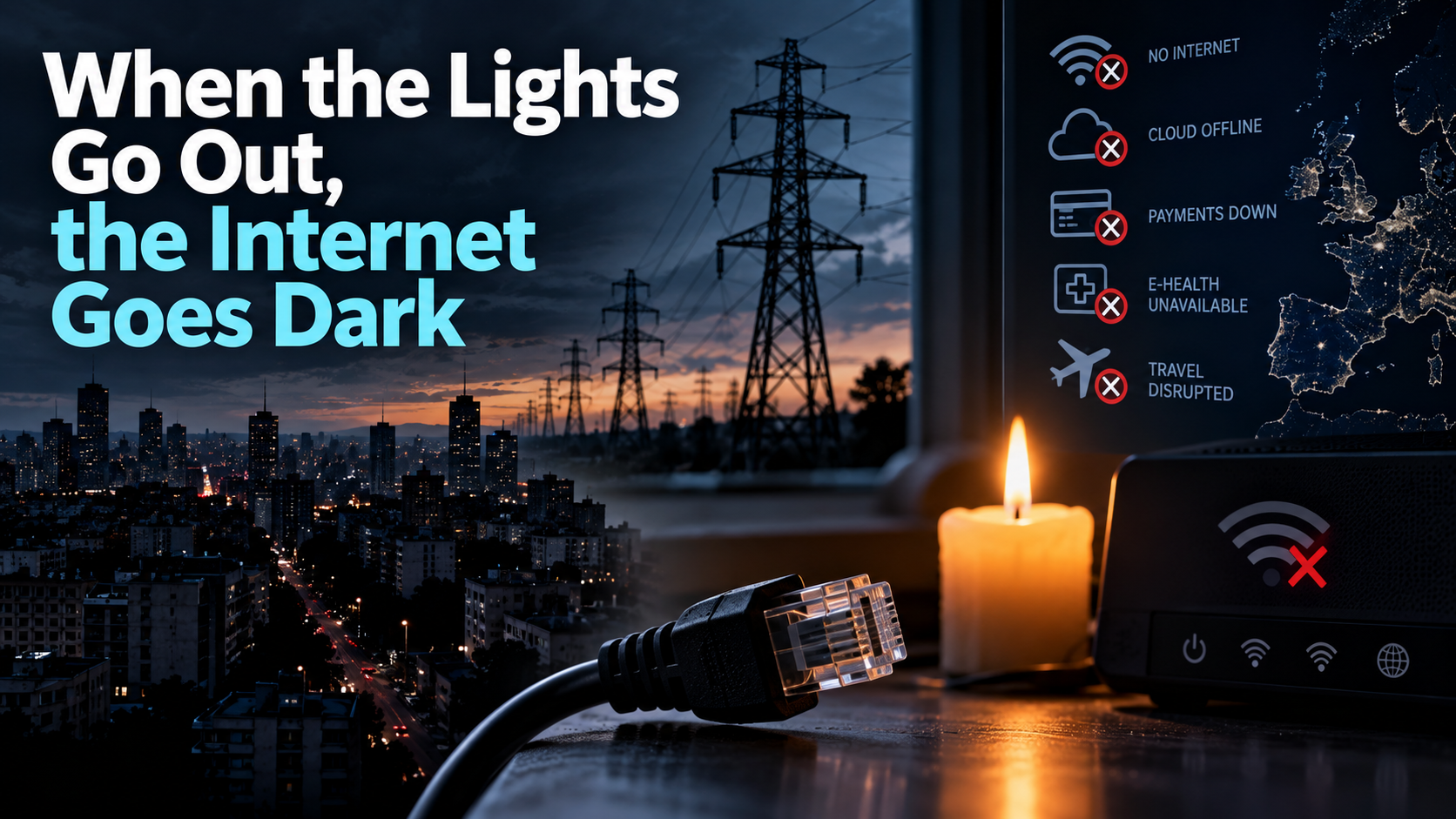
In an age where digital connectivity underpins nearly every aspect of our lives, power outages no longer just mean inconvenience—they threaten the very fabric of our online world. Across Europe, recent energy blackouts have revealed a stark reality: without a resilient and intelligent power infrastructure, the internet and critical digital services can collapse in an instant. This isn’t just about lost electricity—it’s about a digital society brought to a halt.
1. Recent Blackouts: A Growing Pattern
In 2025, several countries across Europe and the Western Balkans have experienced significant power outages, highlighting vulnerabilities in their energy infrastructure. On April 28, 2025, a massive power outage affected much of the Iberian Peninsula, leaving millions in Spain and Portugal without electricity. This blackout disrupted public transport, caused large traffic jams, delayed flights, and left residents unable to access cash from ATMs. While the exact cause remains under investigation, authorities have ruled out sabotage and are focusing on technical issues within the power grid.
In May 2025, North Macedonia experienced a large-scale power outage in major cities including Skopje and Tetovo. The outage was triggered by high voltage in the 400 kW regional portable power grid, causing shutdowns of transformers at several stations transmitting 110 kW mains voltage. Fortunately, electricity supply was restored within an hour. Similarly, Greece faced power disruptions in early 2025 due to high demand and technical failures in the transmission network, affecting key regions such as Athens and Thessaloniki, which resulted in temporary blackouts and service interruptions. Albania also experienced widespread power outages in early 2025, with major cities like Tirana and Durrës suffering from electricity loss caused by problems in the national transmission network.
These incidents were not caused solely by natural disasters or cyberattacks. Instead, they reveal systemic weaknesses in energy grids strained under increasing digital and structural pressures.
Today’s blackouts are no longer merely local inconveniences. In an increasingly digital society, power failures translate directly into digital paralysis—disrupting essential services from financial transactions to healthcare.
2. Building Blackout-Proof Digital Infrastructure
The widespread blackouts across Europe and the Western Balkans in 2025 reveal that energy failures are, in fact, digital infrastructure crises. Today’s society relies on continuous power—not just to light homes, but to keep vital digital services alive. Banking systems, emergency response, transport networks, telecoms, and government operations all hinge on uninterrupted electricity.
Building resilience requires transforming energy systems from reactive to proactive. Artificial intelligence is key. According to a 2024 McKinsey report, AI-powered grid management can reduce blackout risk by 30–40% through better load forecasting, anomaly detection, and dynamic rebalancing. For example, Italy’s Terna grid operator recently deployed AI algorithms that cut outage frequency by 25% in pilot regions by optimizing demand response during peak hours.
Telecommunication infrastructure is a critical backbone for smart grids. 5G networks with ultra-reliable low-latency communication (URLLC) can support near real-time coordination between edge devices and control centers, enabling microsecond responses to grid fluctuations. Yet many telcos remain vulnerable; a 2024 ENISA report revealed over 40% of European telecom operators lack sufficient local energy storage or microgeneration to sustain operations during outages. Strengthening telco power resilience is therefore vital.
Cybersecurity remains a hidden but growing threat. Energy grids are now the most targeted critical infrastructure in the EU, according to ENISA’s 2024 threat landscape report. Many Supervisory Control and Data Acquisition (SCADA) systems were never designed with modern security needs in mind, and patch management remains inconsistent— 40% of grid operators in Central and Southeast Europe still use unpatched legacy software. The 2022 cyberattack on Ukraine’s grid demonstrated how sophisticated intrusions can cause widespread blackouts. Without urgent investment in cybersecurity by design, AI-based predictive systems risk becoming new vulnerabilities rather than safeguards.
Decentralization through microgrids is another essential strategy. Industrial parks, hospitals, and digital hubs must be able to “island” during grid failures, maintaining autonomy for critical services. Microgrids combining local solar or wind generation with battery storage and gas backup can provide 24 to 72 hours of power continuity. For instance, Germany’s Fraunhofer Institute found that microgrid deployment reduced blackout risk for critical infrastructure by up to 80% during grid disturbances.
3. The Investment Case: Resilience as Infrastructure
Blackout prevention is no longer a discretionary expense but a strategic investment in Europe’s digital sovereignty and economic stability.
The European Commission estimates that €584 billion is needed to modernize the EU’s electricity grids by 2030. However, only around 10–15% of this budget is currently allocated to digital resilience, including AI integration and cybersecurity upgrades. This gap leaves Europe vulnerable to escalating blackout risks.
Smart microgrids, AI-powered grid controls, and cybersecurity enhancements for Distribution System Operators (DSOs) and Transmission System Operators (TSOs) must be co-funded through instruments such as the Recovery and Resilience Facility (RRF), the Connecting Europe Facility (CEF2), and national climate and digital strategies.
The Western Balkans face similarly urgent needs. Current estimates place the required investment for grid modernization and digital energy integration at €20–30 billion by 2030. Without this, the region risks frequent blackouts and compromised digital integration with the EU market.
The cost of inaction is steep: beyond direct economic losses—which the European Network of Transmission System Operators for Electricity (ENTSO-E) estimates at €15 billion annually in outage-related costs—there is the erosion of trust in digital services. Consumers and businesses will increasingly question the reliability of digital payments, e-health, and AI-driven services.
Europe’s digital future depends on smart, secure, AI-enabled, and decentralized energy infrastructure—with digital players like telecoms, cloud providers, and cybersecurity firms integrated fully into the energy ecosystem.
No Digital Future Without Energy Resilience
Blackouts are no longer about candles and flashlights — they are about losing access to cloud services, e-health, digital payments, AI systems, and emergency response.
Europe’s digital transformation will fail if energy systems remain vulnerable.
We must invest in smart, secure, AI-assisted, and decentralized power infrastructure, with digital players — telecoms, cloud, cybersecurity firms — brought fully into the energy conversation.
This is no longer about “keeping the lights on.” It’s about keeping the entire digital society running.