
Article from: October 18, 2025
The first Cold War was about ideology: capitalism versus communism, East versus West. The new one is different. The Second Cold War is a war for technological dominance. It’s not fought with tanks or missiles, but with algorithms, data centers, networks, and microchips.
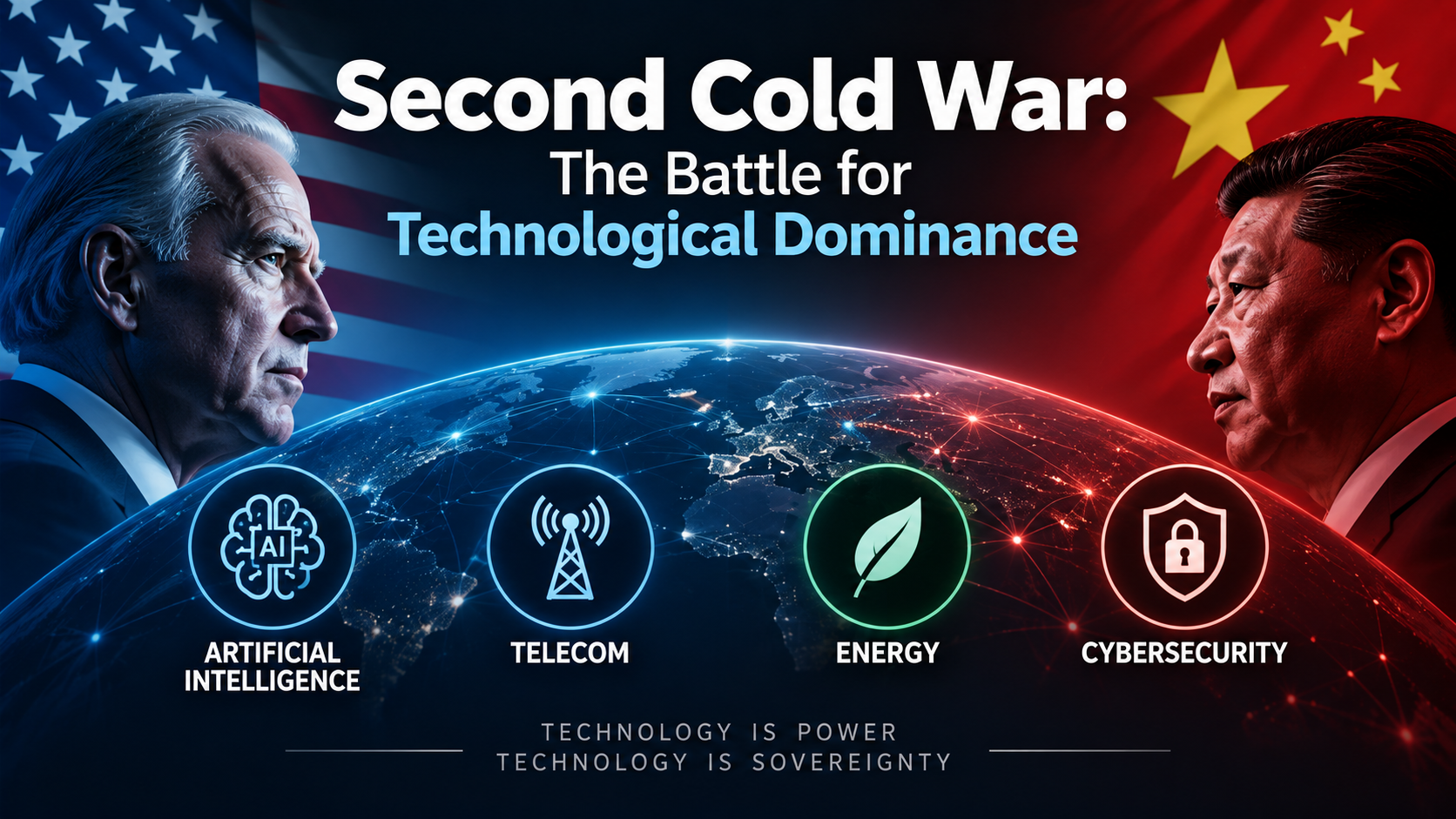
In today’s world, power is no longer measured in the size of your army, but in the strength of your AI models, telecom infrastructure, energy independence, and cyber resilience. The two main players (the United States and China) are shaping a new global order through these four pillars of power.
Artificial Intelligence – The New Nuclear Power
In the 20th century, power was measured by nuclear capability. In the 21st, it is measured by artificial intelligence. The United States still leads in innovation: in AI models, chip design, and global software ecosystems. Companies like OpenAI, Google, and NVIDIA have set the pace for the world.
China, however, is catching up fast. Its advantage lies in scale: massive state-led investment, access to enormous data, and the ability to deploy AI quickly in transportation, surveillance, and manufacturing. The U.S. remains stronger in creativity and open innovation, while China excels in speed and national coordination.
This is not simply a race for smarter algorithms. It is a struggle over who will set the digital standards of the future: who defines how machines think, how data is used, and who controls it. The winner will not only lead in technology, but also in shaping the ethics and governance of the digital world.
Telecom – The Invisible Battlefield
Every great power needs control over its communication lines. In today’s world, the new battlefield is telecommunications. The race for 5G and the upcoming 6G networks determines who controls the global flow of data: the lifeblood of the modern economy.
The United States has focused on software-driven networks, satellite systems like Starlink, and cooperation with allies to ensure secure communications. China, meanwhile, has used Huawei and ZTE to expand its influence across Asia, Africa, and Latin America, building the physical backbone of connectivity.
The difference is striking. America builds systems based on partnerships and open standards. China builds systems based on scale and integration. Both approaches have strengths, but whoever can build a trusted, secure, and affordable global network will shape how societies communicate, trade, and even defend themselves.
Energy – The Foundation of Every Empire
Behind every technological empire lies energy. Artificial intelligence, data centers, electric vehicles, and telecom networks all depend on it. The United States and China are taking two different paths to secure it.
The U.S. is betting on diversification: combining its oil and gas dominance with a strong push into renewables, nuclear, and green hydrogen. Private companies are driving innovation in clean energy and storage, and the country’s energy independence gives it flexibility.
China, in contrast, is betting on scale. It controls over 80% of the world’s production of solar panels and batteries, and leads in rare earth materials: the metals needed for almost every modern technology. Its centralized planning model allows it to coordinate the entire energy chain, from raw materials to manufacturing and distribution.
The U.S. has innovation, China has industrial strength. But the next global superpower will be the one that can combine both: producing clean energy at scale and managing it intelligently through AI-based systems.
Cybersecurity – The New Frontline
If AI is the weapon and telecom the battlefield, cybersecurity is the shield. Wars of the future won’t begin with bombs, but with cyberattacks, on grids, banks, satellites, and data centers.
The United States leads in advanced cyber technologies and international cooperation. Its defense is built on alliances, innovation, and private-sector expertise. China, on the other hand, has centralized its digital defense, integrating cyber control directly into its national security strategy.
Both have strengths, the U.S. in flexibility and innovation, China in discipline and coordination. But in a world where digital systems control everything from hospitals to power stations, cybersecurity has become the true measure of national resilience.
The Architecture of the New World Order
This Second Cold War will not be decided by who has the most soldiers or the largest GDP. It will be decided by who achieves technological sovereignty – the ability to produce, secure, and control the core systems of the modern world.
The U.S. model is based on openness, partnerships, and private innovation. The Chinese model is based on coordination, speed, and state-led execution. Both are building new kinds of empires, one through networks of trust, the other through networks of infrastructure.
The rest of the world, Europe, India, Russia and the Middle East, must navigate between them, searching for balance and independence. In this new age, neutrality is no longer about politics; it’s about technological alignment.
In the end, the winner of this global race will not be the country with the largest army or the biggest economy, but the one that can integrate AI, telecom, energy, and security into a single, coherent strategy.
Because in this century, technology is not only power – it is sovereignty. And the future world order will belong to those who can turn it into real, lasting value for humanity.