
Article from: July 29, 2025
A Deal That Redraws the Energy Map
In July 2025, Donald Trump told European reporters: “Stop the windmills. You’re ruining your countries. I really mean it, it’s so sad.”
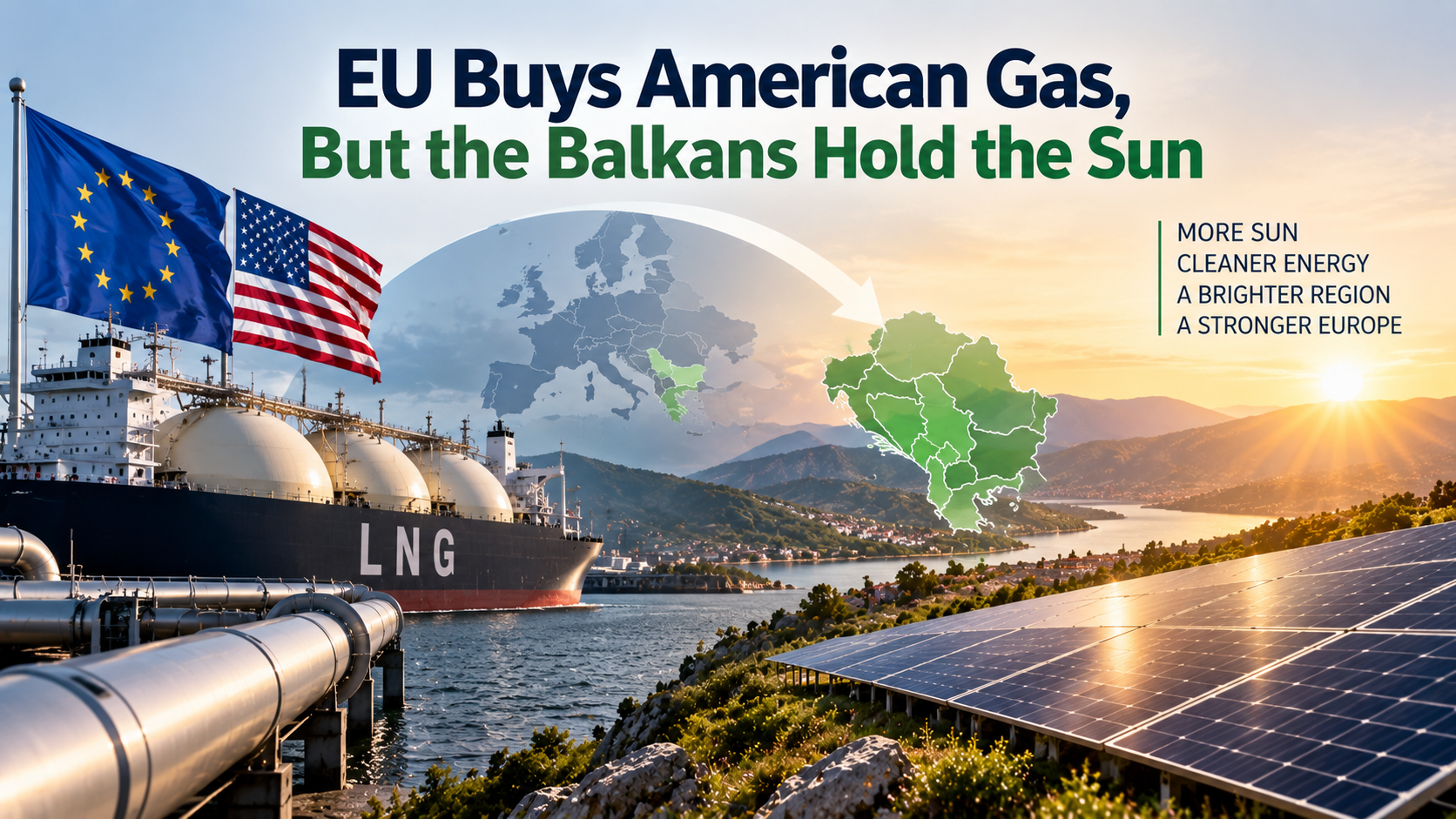
Just days later, the European Union signed an energy and trade agreement with the United States that raises eyebrows far beyond Brussels. Under this deal, the EU will purchase $750 billion worth of American energy over the next three years, roughly $250 billion per year, a figure that approaches 60% of the EU’s current annual energy import bill, which stood at €427 billion in 2024.
At the same time, Europe will invest $600 billion into the U.S. economy, reportedly because its own is “already strong enough.” But for an outsider like myself, from Macedonia outside the EU, this sounds more like dependence shifting from East to West than true resilience.
And while Brussels buys more U.S. gas and nuclear fuel, one question becomes louder: Why isn’t Europe investing more in its own sun?
What Does $750 Billion Actually Mean?
The EU’s annual energy import bill stood at €427 billion in 2024, with fossil fuels still accounting for over 70% of final energy consumption. By committing €250 billion per year to U.S. sources, the EU is locking in a costly, dollar-pegged dependency.
Now, let’s put this number in context.
With €750 billion, Europe could instead finance:
- min. 400 GW of solar PV, with integrated 2-hour battery storage (at ~€1.7 million per MW total cost).
- Or over min. 500 GW of utility-scale solar without batteries.
- Or roughly 8,000 full-scale hydrogen-ready gas turbines for grid balancing.
- Or even fund every grid interconnection project in the EU’s 10-year ENTSO-E roadmap five times over.
By comparison, the entire global turnover of the solar PV equipment market in 2023 was approximately $250–300 billion. This means the EU will spend more on energy imports from the U.S. than the whole planet spends on solar hardware in a year.
This is not just a trade deal — it’s an industrial policy reversal.
Europe Needs Cheap Energy to Survive Electrification
Electrification is happening fast:
- EU electricity demand is expected to rise by 60% by 2040.
- EV charging networks, AI data centers, and green hydrogen electrolysers are already pressuring grids.
- New AI infrastructure alone is projected to quadruple electricity consumption by 2030 in several member states.
At current prices, American LNG can cost €90–100/MWh delivered to Europe. Compare this with:
- Utility-scale solar in Southeastern Europe at €25–30/MWh
- Onshore wind at €40/MWh
- Grid-scale battery discharge cost around €100/MWh — but declining annually
The new EU–US deal will weigh down every digital and green transition target. Unless it’s counterbalanced by ultra-cheap, decentralized renewable power.
Why the Western Balkans Are Suddenly Strategic
From the outside of the EU, countries like Macedonia, Serbia, Albania, Montenegro, Bosnia and Herzegovina, and Kosovo often struggle for relevance in Brussels debates. But in energy economics, their position is changing fast.
Why?
- Higher solar radiation than Germany or the Netherlands (1,400–1,700 kWh/m² vs ~1,100)
- Land and labor costs that are 30–50% lower than EU averages
- Project permitting that, although bureaucratic, is still faster than in Western Europe
- Access to EU-backed funding through IPA III, WBIF, and REPowerEU programs
- Full ENTSO-E grid synchronization, allowing power exports to Italy, Austria, Hungary, Croatia, Bulgaria, Romania and Greece
The Western Balkans can now provide the cheap, flexible, renewable energy that EU countries will need to offset the cost of imported U.S. base energy.
Trump’s Comments Weren’t Just Noise
Donald Trump’s “windmill” critique may sound like political theater, but his policy instincts align with the deal. If you push Europe to abandon wind and domestic renewables, and then offer LNG, oil, and uranium instead — the message becomes clear: Rely on us, not on your windmills.
And Europe seems to have agreed.
But there is a twist: wind can be stopped. Sunlight cannot. Especially not in places like Macedonia, where solar PV output per MW is 25–40% higher than in Northern Europe.
From Skopje, It Looks Like a Window of Opportunity
As someone working at the intersection of solar EPC, digital infrastructure, and AI-based energy management, I see this as an economic opportunity for Eastern and Southeastern Europe.
The EU will increasingly need: Low-cost balancing energy, Localized flexibility for power-intensive technologies, Grid-stabilizing renewables, Clean energy exports from its periphery.
The EU–US deal might just create a market shock big enough to open the doors for a new Eastern European energy strategy — not out of ideology, but out of necessity.