
Article from June 4, 2025
Introduction
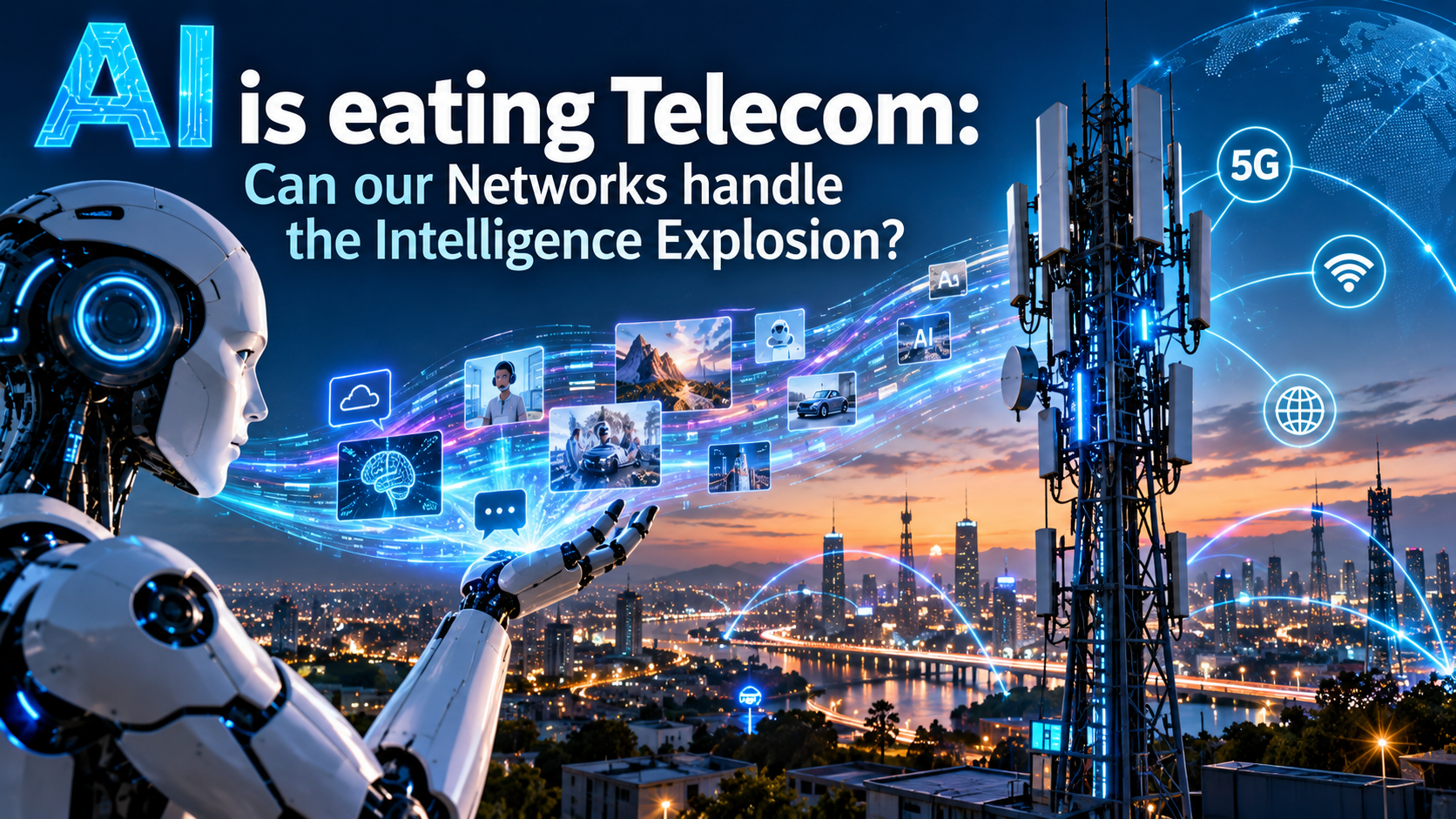
Artificial Intelligence is not just consuming compute—it’s consuming connectivity. The telecom sector, already burdened with explosive video traffic, now faces a new wave: AI-generated and AI-driven data. This is not incremental growth. It’s exponential. And it’s coming faster than many networks are ready for.
This article dives into hard projections for how AI will reshape telecom infrastructure demands in the next 5–10 years—through the lens of traffic, latency, capacity, and energy use.
1. AI and the Coming Data Avalanche
By 2030, global IP traffic is expected to exceed 500 exabytes per month, up from around 200 in 2023, according to Cisco and Omdia. A growing share of this—20–25%—will be attributed directly to AI-driven interactions: inference requests, real-time assistant responses, AI-generated media, and model updates.
AI shifts network behavior from human-initiated bursts to continuous, session-based machine communication. Vector embeddings, multimodal context, and real-time inference chains will contribute to more symmetric and persistent traffic flows across both core and access layers.
The load will not be evenly distributed. AI-assisted applications (like real-time copilots and assistants) will create localized traffic spikes at the edge, while LLM training and multi-agent orchestration push bulk flows through backhaul and core transit.
According to McKinsey, total inference-related network traffic could increase by 15–20× by 2030, with over 90% of that growth occurring outside traditional peak hours.
2. Latency: The Silent Constraint
Latency is the hidden cost of AI at the edge. While today’s networks can deliver sub-30 ms latency for high-quality mobile broadband, AI applications—especially interactive and real-time systems—demand sub-10 ms end-to-end performance. Gartner estimates that by 2030, 30% of mobile and enterprise network use cases will require deterministic latency below 5 ms.
This is not achievable without fundamental shifts in architecture. New applications—like autonomous decision-making, AR/VR with embedded AI, and predictive edge analytics—will require:
- Distributed compute at the RAN and aggregation layers
- Dynamic spectrum slicing tuned to AI inference loads
- Inference-aware traffic scheduling, where decisions are made not just on bandwidth but also compute proximity
Future networks must behave more like real-time operating systems than passive conduits. Scheduling, prefetching, and context caching will be vital, managed by AI-native orchestration layers.
3. Capacity and Signaling at Scale
AI systems drive traffic not just in volume, but in structure. Multimodal applications require low-latency upstream requests, distributed model calls, and downstream delivery of synthesized responses—often in seconds, and often in high-resolution formats.
This is a full-duplex workload pattern, which breaks legacy assumptions about mobile usage behavior.
GSMA Intelligence predicts that average cell site backhaul will need to grow by 5–7× by 2030 in urban and dense suburban areas to accommodate AI-driven data flows. Open RAN and vRAN deployments will further increase backhaul and midhaul sensitivity, particularly for centralized units (CU) managing AI-enabled orchestration.
Beyond bandwidth, signaling pressure will increase. AI-enabled IoT and device swarms (e.g. industrial automation, urban mobility) could push connected device density past 1 million/km² in some use cases, according to Huawei and ETSI forecasts. Network architectures will need to support ultra-reliable low-latency access (URLLC) at this density without saturating the control plane.
4. Energy: The New Bottleneck
Telecom networks already consume 2–3% of global electricity, with the RAN typically responsible for over 60% of that. The rise of AI—not just in the cloud, but within telecom itself—will significantly increase this footprint.
By 2030, combined telecom-AI systems are projected to require 4.5–5.5% of global electricity, according to estimates by the IEA and Bell Labs. This includes:
- AI-powered network operations (SON, predictive maintenance, anomaly detection)
- AI traffic orchestration and inference at the edge
- Support for AI-driven applications on end-user devices
What makes AI different is power density and thermal load. A typical AI inference node at the edge may consume 5–10× more energy per unit of traffic than a standard RAN node, especially in dense deployments where active cooling and power redundancy are required.
To manage this, operators will need to integrate:
- Energy-aware routing and task scheduling (shifting inference to off-peak or renewable-heavy zones)
- Local energy generation (solar, microgrids, SMRs) co-located with compute infrastructure
- AI energy optimization (quantization, batching, dynamic model scaling)
Without such interventions, energy-related OPEX could increase by 30–40% by 2030, eroding margins and conflicting with telcos’ net-zero goals.
5. Investment and Architectural Outlook
IDC forecasts that global telecom investment will need to increase by $500–800 billion through 2035 to keep pace with AI-driven infrastructure demands. This includes:
- Expansion of edge compute zones
- AI-native orchestration stacks
- Redundant, high-capacity optical backbones
- Dense access layer upgrades for latency and energy efficiency
Beyond capital, this requires a new design mindset. Networks must be modeled not around “users” but around AI agents—each with compute, latency, and energy requirements negotiated in real time.
Orchestration platforms must evolve from static slices to intent-based, self-optimizing fabrics, where AI manages traffic, power, and compute holistically.
Conclusion: Telecom as an AI Substrate
Telecom is no longer just a platform for delivering data. It’s becoming a substrate for intelligent systems—distributed, autonomous, and compute-integrated. And that changes everything.
We are entering a phase where the dominant load on networks won’t be human, but machine—running 24/7, demanding milliseconds, and powered by models whose inference alone reshapes traffic and energy curves.
The question isn’t whether AI will overwhelm legacy networks—it’s how fast operators can adapt, architect, and optimize before it does.
If AI is the new electricity, then connectivity is its grid—and telecom must rewire itself before the breakers trip.