Article from: May 31, 2025
Introduction
Artificial Intelligence (AI) is no longer a futuristic concept—it’s embedded in daily life, powering everything from search engines and chatbots to logistics, finance, and industrial control. But as AI adoption accelerates, a new question is emerging at the heart of the energy transition: How much electricity will AI consume, and how will we power it sustainably?
The numbers are sobering. AI is poised to become one of the largest new sources of electricity demand globally, and it’s arriving fast. Yet this challenge could also become a historic opportunity—if renewables and nuclear work together.
The Surging Energy Appetite of AI
The International Energy Agency (IEA) projects that by 2030, global data centers will consume over 900 TWh annually — nearly double today’s levels. And AI workloads will account for a growing slice of that, particularly with the rise of generative models like ChatGPT and text-to-image engines.
To put that in perspective: AI-related electricity demand by 2030 could rival the entire consumption of a G7 country like Japan.
An average AI user might consume 600 kWh/year — roughly 15% of global per capita electricity use. For power users, that could exceed 2,000 kWh/year, more than the total consumption of a typical Indian citizen.
AI vs. Traditional Digital Tools
AI is energy-hungry.
Each AI query can consume up to 0.0029 kWh — nearly 10x more than a standard Google search. If search platforms shift entirely to AI models, the impact could be enormous.
Example: If all 9 billion daily Google searches switched to AI-generated answers, we’d add 10 TWh of annual demand — equal to the output of an average nuclear power plant.
AI’s Share of Electricity Use: The Growing Divide
For a typical AI user running 10 queries per day, annual usage may reach 210 kWh. For heavy users pushing 100+ queries daily, that grows to 2,090 kWh/year.
Compare that to:
- Global average electricity use per capita: ~3,700 kWh
- India: ~1,360 kWh
- North Macedonia: ~3,950 kWh
A heavy AI user could soon consume more electricity for AI alone than the entire annual use of someone in India.
Can Renewables and Nuclear Power the AI Boom?
Yes — but only if they collaborate.
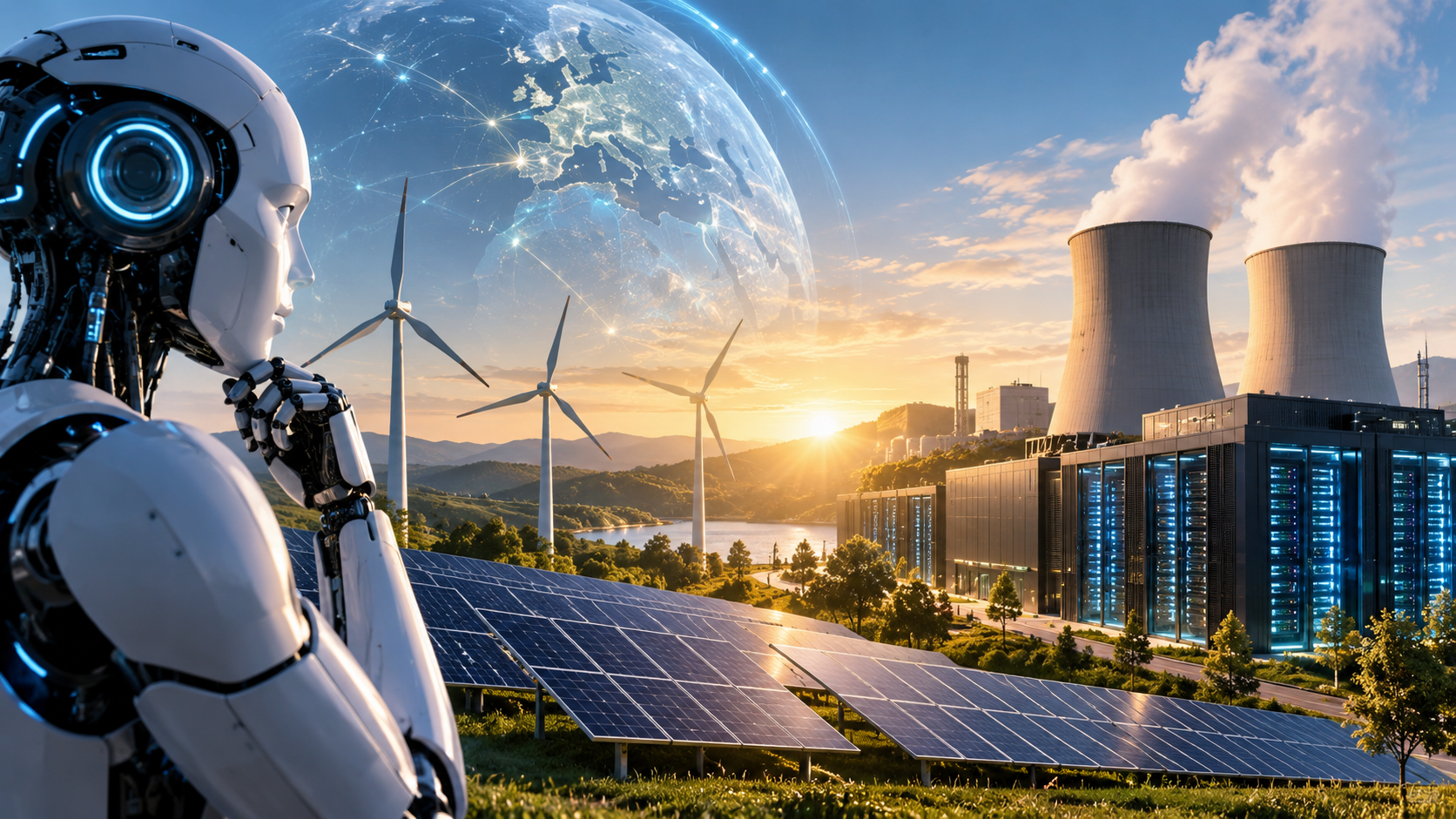
AI’s energy profile demands three things: scale, stability, and sustainability. No single energy source can do it alone. But together, renewables and nuclear offer a realistic path forward.
Renewables: Fast, Cheap, and Variable
Solar and wind are now the cheapest sources of new electricity in much of the world. Annual capacity additions are accelerating, and small-scale systems like rooftop solar are helping decentralize power.
But renewables are variable. They don’t always generate when needed — which is a challenge for data centers and AI models that demand constant uptime for training and inference.
Nuclear: Stable, Clean Baseload Power
Nuclear energy fills that gap:
- Provides 24/7 power
- Produces zero carbon emissions
- Requires minimal land
- Offers grid stability, especially during nighttime or winter
New tech like Small Modular Reactors (SMRs) can be sited closer to data centers, reducing grid congestion and transmission losses.
Why Renewables and Nuclear Must Work Together
AI is not just a tech challenge — it’s a grid challenge.
- Solar powers AI tasks during the day.
- Wind fills seasonal gaps.
- Nuclear keeps operations stable at night and during weather lulls.
- Batteries buffer the fluctuations.
Together, they create resilient hybrid systems that keep emissions low, performance high, and costs manageable.
The Infrastructure Opportunity: Distributed AI + Clean Energy Hubs
One of the smartest moves now is to co-locate modular AI data centers with renewable energy sites, especially in rural or underutilized regions.
Benefits:
- Cuts transmission costs
- Uses solar/wind energy that might otherwise be curtailed
- Reduces stress on urban grids
- Spurs economic activity in new areas
Regions like Southeast Europe, North Africa, and the U.S. Southwest could become global hubs for “clean AI,” leveraging abundant solar, wind, and next-gen nuclear.
Conclusion: A Clean Energy Pact for the AI Era
AI is the fastest-growing consumer of electricity in the 21st century. How we power it will shape everything from digital equity to climate outcomes.
The energy system of the 2030s is being written now — in the lines of code behind neural networks, and in the blueprints of solar farms, wind parks, and modular reactors.
To succeed, we need both renewables and nuclear, not in competition — but in synergy.
Because this isn’t AI vs. climate. It’s AI for climate — but only if we power it clean.