
Article from June 17, 2025
Link:
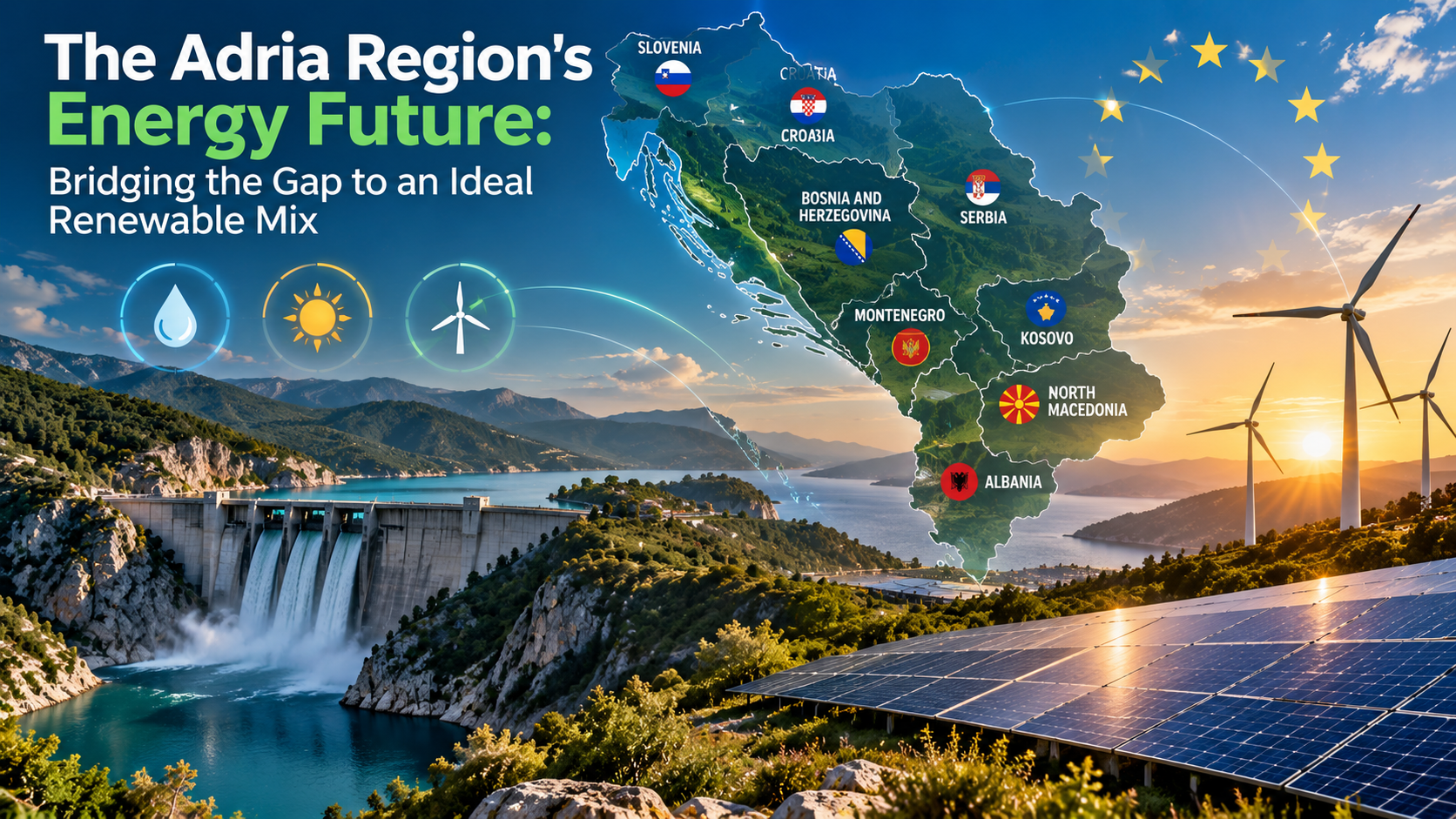
The countries of the Adria region—Slovenia, Croatia, Bosnia and Herzegovina, Montenegro, Serbia, Kosovo, North Macedonia, and Albania—share a unique energy legacy. Once part of a unified grid (ex-Yu), their energy systems still bear the imprint of historical development, primarily a strong reliance on hydropower. Today, as they navigate the imperative of decarbonization and European Union integration, a critical question emerges: how close are they to an “ideal” renewable energy mix, and what does that ideal look like?
The Blueprint: An Ideal Technical Mix
Academic and engineering studies, focusing purely on technical parameters for grid stability and resource complementarity, offer a compelling blueprint for an ideal renewable energy mix. One such model, designed to achieve a low-carbon electricity supply while effectively balancing variations using existing hydropower reservoirs, suggests the following composition:
- Hydropower: 50%
- Solar PV: 37%
- Wind: 9%
This mix emphasizes the dispatchable nature of hydropower to firm up intermittent solar and wind generation, creating a resilient and stable system.
The Current Reality: An Adria Region Snapshot
When we aggregate the latest available renewable electricity generation data (primarily from 2024 and 2023) for these eight countries, a different picture emerges. Considering only hydropower, solar PV, and wind generation, the current combined mix is:
- Hydropower: Approximately 85.15%
- Solar PV: Approximately 3.02%
- Wind: Approximately 11.84%
This highlights a significant reliance on hydropower, which, while a clean energy source, can introduce vulnerabilities due to fluctuating hydrological conditions. Albania, for instance, is almost entirely dependent on hydropower, making its electricity generation susceptible to droughts.
The Disparity: A Call for Diversification
The comparison reveals a substantial gap between the current state and the technically ideal mix:

The most striking disparity is the over-reliance on hydropower and the significant underutilization of solar PV. While the region has made strides in wind energy, its share is still slightly above the ideal, indicating that the overall balance needs adjustment.
This imbalance poses challenges for grid stability and energy security, as an over-dependence on a single source, even a renewable one, can lead to vulnerabilities during periods of low water levels or other climatic variations.
The Adria Region’s Renewable Trajectory
The countries of the Adria region are actively pursuing ambitious targets to transform their energy landscapes:
- Current Renewable Share from Total Electricity Generation: As of the latest available data (primarily 2023–2024), approximately 42.75% of the total electricity generated across the Adria region comes from renewable sources.
- 2030 Targets: Individual countries have set varying, yet ambitious, goals for renewable energy integration by 2030. These targets for renewable energy share in gross final energy consumption or national energy mix generally range from 33% to 50%.
- 2050 Targets: The overarching goal for most countries in the Adria region is to achieve climate neutrality or net-zero emissions by 2050. This implies a near 100% renewable energy share in electricity generation, with significant decarbonization across all sectors.
The European Union’s Green Ambition
The European Union, a key partner and aspirational framework for many Adria region countries, has its own set of ambitious renewable energy targets:
- Current Renewable Share from Total Electricity Generation: In 2024, 47.4% of the net electricity generated in the EU came from renewable energy sources.
2030 Targets:
- The EU has a binding renewable energy target for 2030 of a minimum of 42.5% in its overall energy mix, with an aspiration to reach 45%.
- Specifically for electricity generation, intermittent renewables are projected to constitute 54% of the mix by 2030
2050 Targets:
- The EU’s overarching goal is to become the first climate-neutral continent by 2050, achieving net-zero greenhouse gas emissions across all sectors.
- This transformation implies that electricity production needs to be almost entirely emission-free, with nearly 90% of net installed electricity production capacity from all renewable types by 2050.
- More broadly, renewables are expected to make up two-thirds (66%) of total energy consumption and 86% of power generation
Adria vs. Europe: A Comparative Outlook
Here’s a snapshot comparing the Adria region and the European Union across key renewable energy metrics:

The Adria region is currently positioned slightly behind the European Union in terms of its overall renewable energy share in total electricity generation. However, the ambitious 2030 targets set by individual Adria countries demonstrate a strong commitment to align with EU goals, indicating a clear intent to accelerate their energy transition.
The primary challenge for the Adria region lies in the pace and effectiveness of implementation. Overcoming the historical reliance on hydropower, significantly boosting solar PV deployment, and modernizing aging grid infrastructure will be crucial. While the EU benefits from a more diversified renewable growth trajectory, the Adria region has immense untapped solar and wind potential.