Article from: July 10, 2025
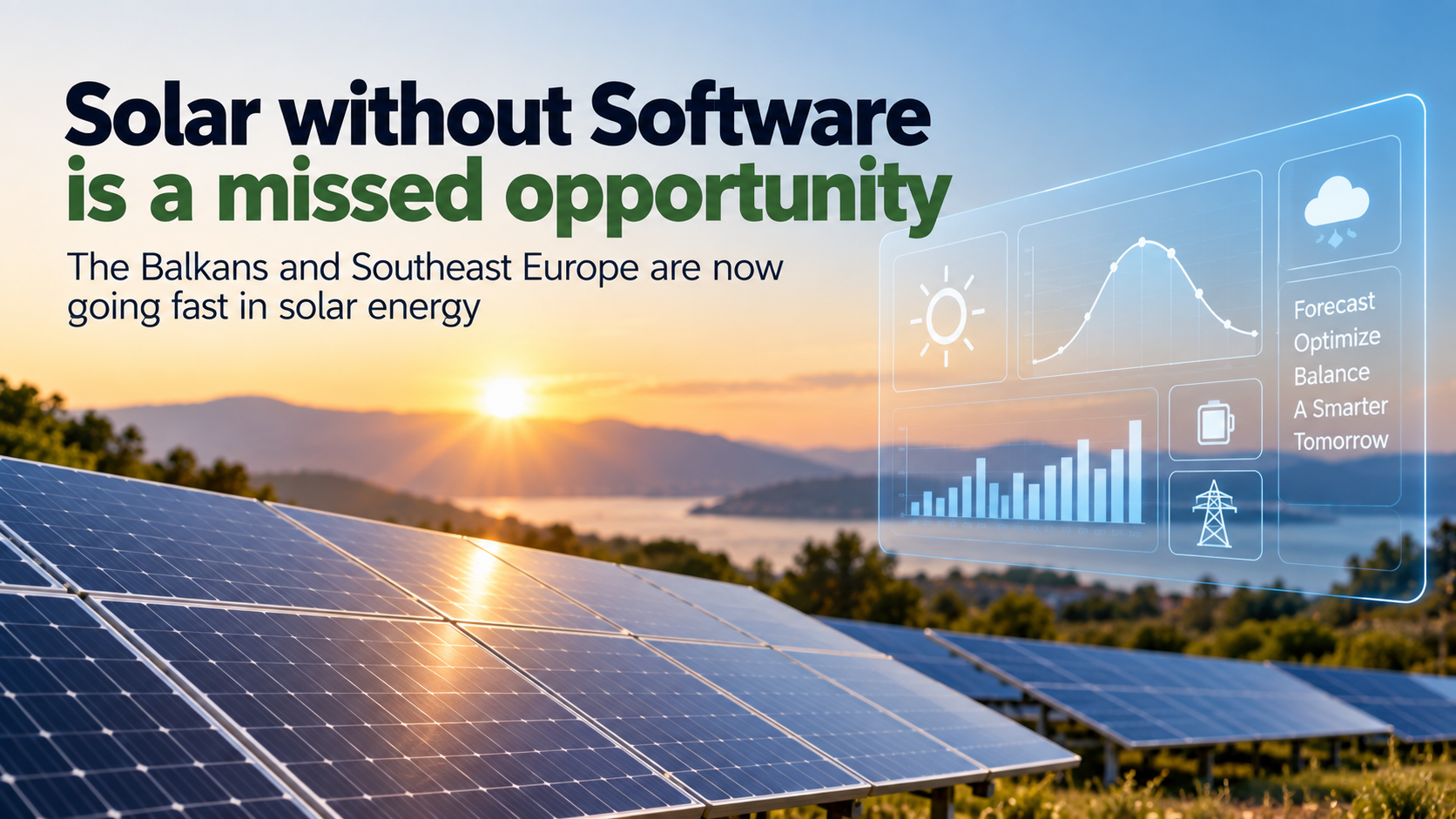
The Balkans and Southeast Europe are now going fast in solar energy
Prices are low, investors are active, and governments are finally removing some barriers. Big solar parks are announced every week. But there is a risk we don’t talk about enough: we are building solar power plants without smart systems. Without software, without forecasting, without digital tools.
We focus a lot on the hardware (panels, inverters, transformers) but we forget that in 2025, solar is not just about equipment. It is also about data, intelligence, and flexibility. If we don’t include the digital layer now, we will build solar capacity that is blind, passive, and not ready for the next step of the energy transition.
Why Software is so important for Solar
Solar energy is not constant. It goes up and down during the day, and depends on weather. If we want solar to be main energy source in the grid, it needs to be well managed. This is where software plays the key role.
Modern solar power plants should use Energy Management Systems (EMS), digital forecasting tools, and automatic communication with the grid. Without this, we cannot participate in flexibility markets, we cannot optimize storage, and we cannot support grid balancing. Even basic things, like knowing how much we will produce tomorrow, can be done better with AI models trained on weather and historical data. Without EMS, the plant cannot react fast to problems or to market prices. And without good digital connection to the grid operator, the system becomes harder to manage and more expensive for everybody.
What we see in Western Europe
In Germany, Spain, and Italy, solar plants already work with full digital integration. They don’t just produce electricity, they also help to balance the grid. EMS is now standard, not just for big plants but also for medium-size systems. Predictive maintenance, real-time diagnostics, and automatic curtailment response are now normal. Even synthetic inertia and reactive power support are being done from solar plants, thanks to software.
These tools are available also for us in the Balkans. But they are still not used in most projects. Developers are focused only on speed and cost. The digital part is forgotten, or added later with very limited function. This is a mistake.
What we can do in the Balkans
Countries like North Macedonia, Serbia, Albania, Croatia and Bosnia are all moving fast with new solar projects. The targets are high, the land is available, and the sun is strong. But we are not building with long-term thinking.
The Balkan region has a big advantage. Our grid infrastructure is still connected from the old Yugoslavia system. This allows regional balancing, energy trading, and cross-border flexibility. But for this to work, solar plants must be able to send real-time data, react to grid requests, and adjust production. This is only possible with proper software and EMS. Without it, solar becomes a problem, not a solution, for the grid.
Where we need to improve
We need new rules. Governments should ask for digital standards when giving permits. Developers should work with software companies, not only EPCs. Transmission and distribution operators must build better systems for digital visibility and control. And investors must understand that smart solar will have better long-term value, lower curtailment risk, and more stable revenues.
Also, cyber security becomes more important. If a solar plant has no digital monitoring or defense system, it is open to risk. Attacks on energy infrastructure are growing, and EMS can help prevent or respond faster.
Take away
In this region, we are good in engineering. We know how to build power plants. But now, we must also become better in digital energy. Because solar without software is just a basic machine. It cannot see, it cannot react, and it cannot improve.
If we want to build serious, future-proof energy systems, we need to build them smart. That means solar with brains, not just panels on a field.