
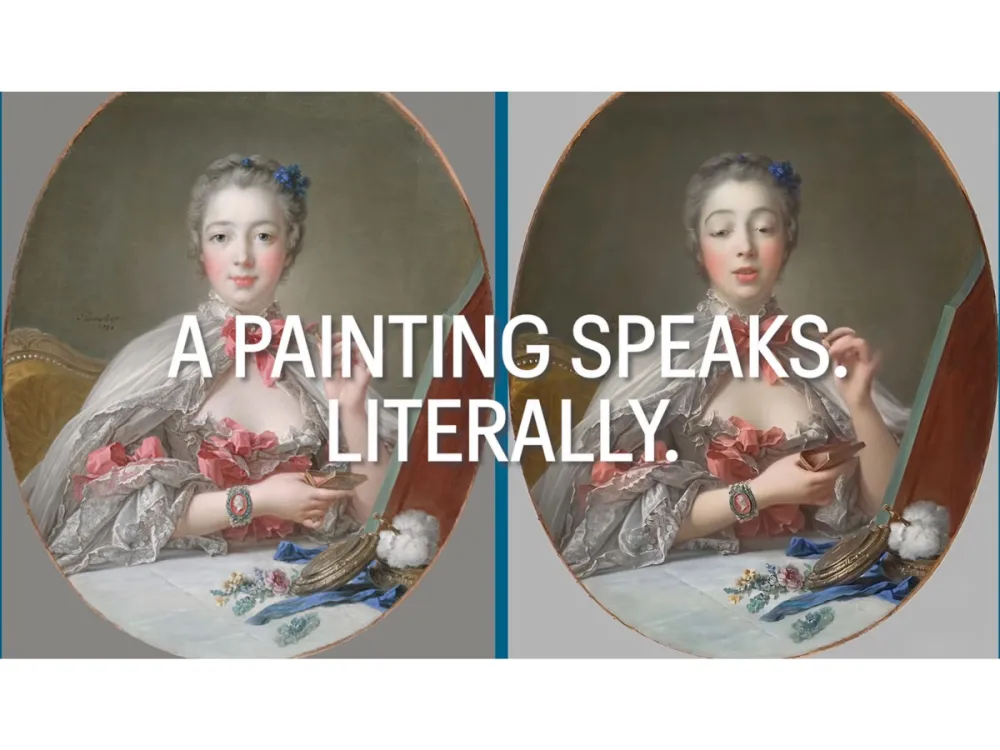
The Harvard Art Museums, a consortium of three institutions in Cambridge, Massachusetts, tested out a marketing campaign aimed at increasing visitor engagement and membership that makes use of generative AI in order to animate a 18th-century painting in its collection.
John Connolly, the director of marketing for the Harvard Art Museums, and Julian De Freitas, an assistant professor at Harvard Business School, recently spoke about the initiative on Cold Call, a podcast produced by the Harvard Business Review and hosted by Brian Kenny HBS’s chief marketing and communications officer.
De Freitas’s research “addresses questions about how consumers perceive, adopt, and interact with AI systems,” Kenny says. For the case study, which De Freitas published earlier this year, he and his team created a talking video version of François Boucher’s Jeanne-Antoinette Poisson, Marquise de Pompadour, a 1750 portrait of one of French king Louis XV’s mistresses, as well as a chatbot that people could have a conversation with. The video version of the episode includes a short snippet of the animation.
Introducing the episode, Kenny asks if subjecting the Boucher portrait to this type of generative AI, “would it help people connect with art or distract from it? Could AI broaden engagement without compromising authenticity? And who gets to decide what an artwork would say?”
He adds, “This case is about far more than a marketing experiment. It’s about innovation versus stewardship, technology versus interpretation, and how institutions rooted in history navigate a rapidly changing future.”
In the interview, De Frietas says the campaign was beta-tested with some participants receiving one version of the AI instantiation, and others receiving the other. The museum hasn’t officially rolled it out as a public campaign, and it’s currently not accessible on the museum’s website or social media channels, though, as Connolly teases in the podcast, “It could suddenly drop.” (Connolly declined to comment further on the project to ARTnews.)
And what did the participants make of the campaign? Connolly says, “There was some positive feedback. There was some negative. The negative feedback generally fell with the perception of AI out there. … That was the problem. But people did appreciate what we were trying to do and were blown away by the technology itself. And some people have found it funny, good old-fashioned humor.”